JCR Pharmaceuticals Case Study
Caso práctico
The Challenge of Global Transformation

JCR Pharma, which celebrated its 50th anniversary in 2025, is a pharmaceutical company headquartered in Ashiya City, Hyogo Prefecture.
With deep strengths in biopharmaceutical development, JCR Pharma stands together with patients suffering from rare diseases around the world to fight illness.
The company has pursued the challenge of creating value as an R&D-oriented drug manufacturer with a global presence. This is the story of JCR Pharma transforming itself into an organization capable of competing globally.
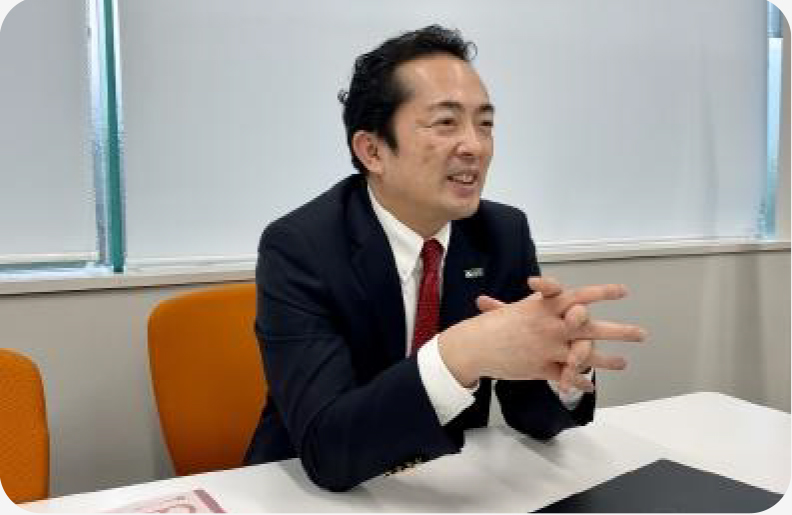
Naoki Kawada
General Manager, Corporate Strategy Department, Corporate Strategy Division
Joined JCR Pharmaceuticals in 2000 as a researcher. Spent many years in the development division running clinical trials, and from the 2000s onward took on a range of planning roles for JCR Pharma’s development pipeline. In his current role since 2018, he is now focused on shaping the management strategy and strengthening the organization to grow the business globally.
——How did JCR Pharma’s global transformation begin?
When I joined in 2000, JCR was still a company of about 100 to 120 people, with only two products dating back to its founding: a urine-derived product and a growth hormone product. In the 1990s, concerns over unknown risks from biologically derived ingredients led the company to pivot toward biopharmaceuticals. The first decade of the 2000s was largely spent developing JCR’s first biopharmaceutical, erythropoietin. Looking back, I don’t think we were yet thinking explicitly about “going global” at that point. But it was also becoming harder for a Japanese pharmaceutical company to grow significantly within Japan alone, with the population aging and shrinking and drug prices being cut steadily under the national pricing system. And it typically takes more than ten years for a pharmaceutical company to bring a single product to market.
A ten- or twenty-year horizon may sound long for an ordinary company, but in the rhythm of pharmaceutical product development, if you don’t start looking that far ahead you simply won’t make it in time. Against that backdrop, our 2009 capital alliance with a British pharmaceutical company became the trigger, and from there the pace of globalization accelerated rapidly.
We are focused on developing people who can communicate globally — not just people who speak English, but people whose presentation skills and leadership add up to true cross-cultural communication.
——And how are you developing the “global talent” to match that direction?
Talent development is one of our biggest challenges. Being able to do business in English is, of course, a baseline skill. But beyond just speaking English, we put a lot of effort into developing people who can communicate globally as a whole — including presentation skills and leadership.
I said “English is a must,” and I’m one of the people still actively studying it. I started learning with NEI in 2017. Studying gets tough once you pass forty (laughs). But just like brushing your teeth or eating, the trick is to make English study part of daily life — once it becomes a habit, it stops feeling like an effort. And one day you realize you’re hearing it and speaking it without thinking about it.
Personally, what I like about NEI is how low the barrier to getting started is. The lessons are online so there’s no commuting; each session is about 30 minutes which is flexible; and the content is tied directly to your own work and interests, so it doesn’t feel like you’re bracing yourself to “study English.” The company currently covers 100% of the cost and HR training tracks each person’s progress, but it’s also reassuring that the program works regardless of someone’s English level or job function.
——What is JCR Pharma’s outlook from here?
JCR Pharma is now in the middle of a true transition to a globally operating company, getting our products for rare diseases to patients around the world. We’ve grown past 800 employees, but the great majority are Japanese, and the underlying organization still operates in a Japanese business style with a global perspective layered on top.
Since taking on this role, opportunities to communicate in English — meetings with overseas institutional investors and so on — have grown significantly. When I first started training with NEI I had no confidence speaking English and relied on an interpreter, but at some point I found myself talking directly with no interpreter at all. Feeling your own progress is the strongest motivation there is.
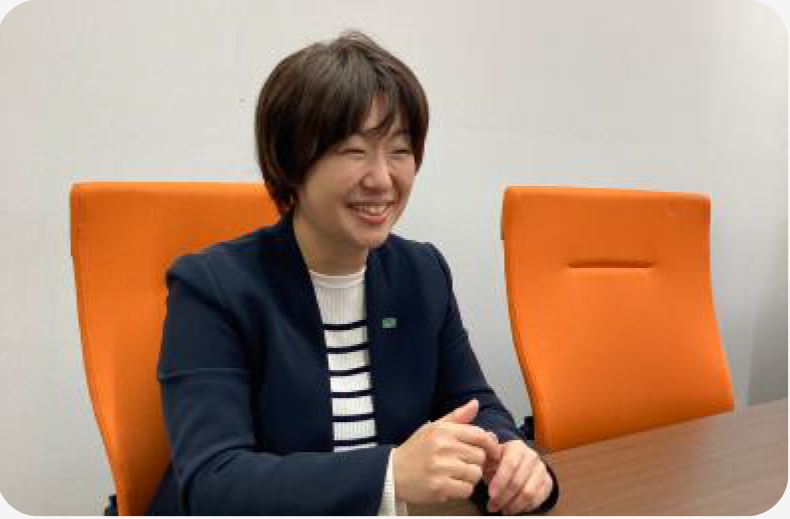
Ayako Watari
Deputy General Manager, HR Planning Department, Administration Division
We first met NEI, who provides English training to JCR Pharma, in 2017. Our chairman and president Mr. Ashida has said, “At our scale, expanding globally on our own is difficult.” There are many ingredients to a successful partnership with an overseas company, and one of them is effective, high-impact communication. That is the reason NEI was chosen as the means of building our global communication capability.
Employees who have built confidence through NEI training — including younger members — actively speak up in English in presentations and discussions with overseas companies, and motivation to acquire English is very high among employees themselves, with people voluntarily switching their team meetings into English.
We set NEI Score targets inside the “self-development” category of the personnel evaluation, evaluating people on the visible growth in their score. We also use the score as one of the shared indicators across the organization.
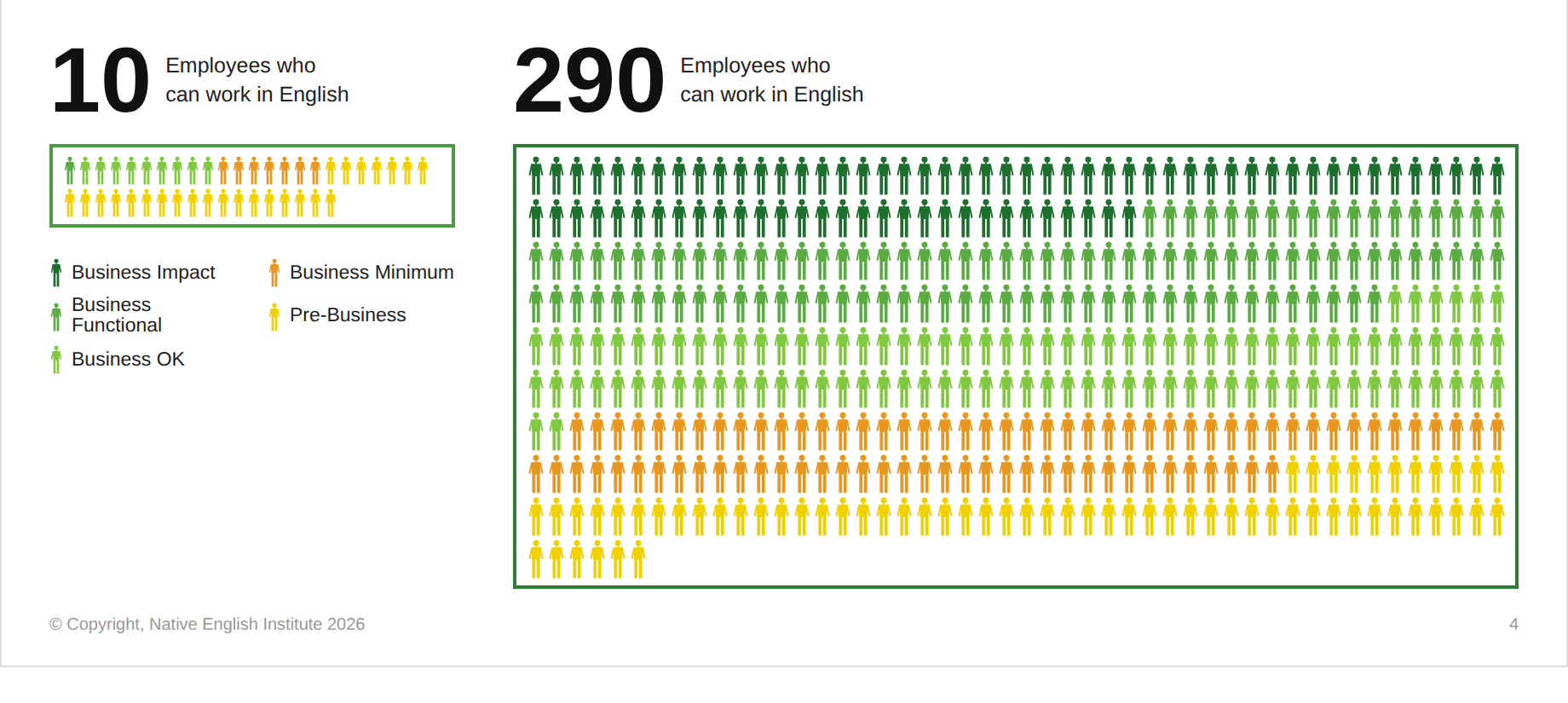
In 2017, 52 JCR Pharma employees were enrolled with NEI. As of April 2026, 438 JCR Pharma employees have taken part.